
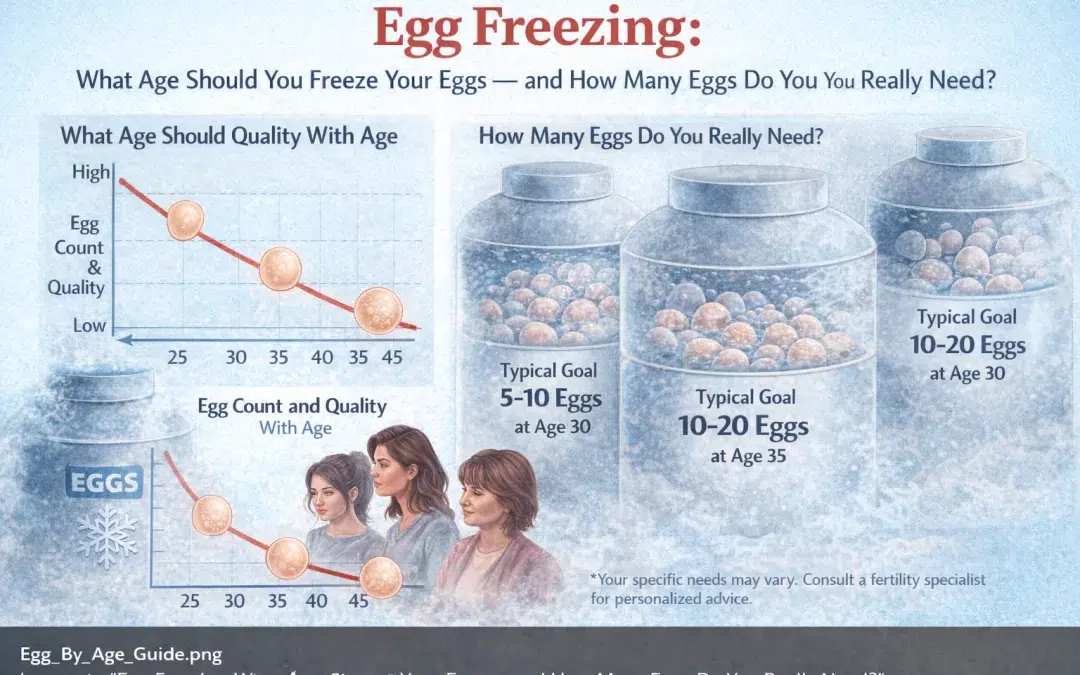
Egg freezing has become increasingly common, particularly for women who know they would like children in the future but are not ready to start a family now.
One of the most common questions I am asked is:
“Am I too young to freeze my eggs?”
Very quickly followed by:
“How many eggs do I actually need?”
The answer is not simply 10, 15 or 20 eggs.
The two most important factors are your age when the eggs are frozen and the number of mature eggs you are able to store.
And there is something else I think every woman considering egg freezing should understand from the beginning:
Egg freezing is not an insurance policy and it cannot guarantee a baby.
I prefer to think of it as creating a Plan B.
The aim is to preserve some of the reproductive potential you have today, in case you need it in the future.
What is the best age to freeze your eggs?
Biologically, younger is better.
A woman’s fertility changes with age because both the number and quality of her eggs decline over time. Importantly, freezing eggs pauses the biological ageing of those particular eggs.
If you freeze eggs at 33 and return to use them at 39, the eggs are still biologically the age they were when they were frozen.
That is the fundamental reason egg freezing works as a fertility-preservation strategy.
In my practice, I generally tell women that if you know you are likely to delay starting a family, ideally have the conversation about egg freezing before 35.
That does not mean 35 is a cliff.
It certainly does not mean that egg freezing at 36, 37, 38 or later is pointless.
It means that as age increases, we usually need more eggs to achieve the same probability of a future baby.
This relationship between age and outcomes is consistently demonstrated in the scientific literature. The American Society for Reproductive Medicine (ASRM) concludes that outcomes following planned oocyte cryopreservation are better when eggs are frozen at younger rather than older ages.
More recently, a 2024 systematic review and meta-analysis of planned egg freezing found a clear relationship between age at freezing and subsequent live birth outcomes.
“Have I left it too late?”
So when a woman in her late 30s asks me:
“Have I left it too late?”
my answer is usually more nuanced.
It may not be the ideal age at which we would have chosen to freeze your eggs.
But these are also the youngest your eggs are ever going to be.
The question then becomes whether freezing eggs now gives you a meaningful additional reproductive option for the future.
How many eggs should I freeze?
This is where egg-freezing counselling needs to become individualised.
There is no magic number of eggs that guarantees a baby.
The chance that one frozen egg will eventually become a baby is not 100%.
An egg has to:
- survive warming,
- fertilise,
- develop into an embryo,
- continue developing to the appropriate stage,
- implant,
- and ultimately result in a live birth.
Age influences several parts of that pathway, particularly the likelihood that an egg will ultimately produce a chromosomally normal embryo.
Therefore:
10 eggs frozen at 30 are not equivalent to 10 eggs frozen at 40.
This is why I don’t like giving women a single target number without putting their age beside it.
What does the research tell us about the number of eggs needed?
Several important studies have attempted to answer this question.
In a landmark 2016 study, Doyle and colleagues examined outcomes following vitrification and warming of human oocytes and estimated the number of mature eggs required to achieve a reasonable probability of live birth.
Their modelling estimated that approximately:
- 14 mature eggs at age 30–34
- 15 mature eggs at age 35–37
- 26 mature eggs at age 38–40
would be required to reach approximately a 70% probability of one live birth.
These numbers should not be interpreted as guarantees or universal targets. They came from particular populations and laboratory settings.
Another influential study by Goldman and colleagues, published in Human Reproduction in 2017, developed a counselling model using a woman’s age and number of mature eggs frozen to estimate her probability of having one or more live births.
The message from both studies is much more important than any individual number:
Age and egg number work together.
As age increases, more eggs are generally required to achieve a similar probability of future live birth.
The ASRM guideline therefore appropriately cautions against telling every woman that a particular number of eggs will guarantee a reasonable chance of a baby. The available evidence simply does not support one universal number.
Why I use our own egg-freezing calculator when counselling patients
This is an important part of how I personally counsel women considering egg freezing.
There are several published international models estimating the likelihood of a future baby from frozen eggs.
They are useful.
But when I am counselling a patient whose eggs are going to be frozen, stored, warmed and used within our laboratory network, I also want to look at our own laboratory experience.
I therefore use the Egg Freezing Australia/Virtus egg-freezing calculator during consultations.
Rather than relying only on overseas studies, the calculator allows us to look at estimates generated from data from the laboratory network in which my patients are actually being treated.
That distinction matters to me.
Different laboratories can have different experience, techniques and outcomes with oocyte vitrification and warming. Even the landmark Goldman model acknowledged that outcomes may vary between centres and that individual clinics should consider their own laboratory performance when counselling patients.
How I use the calculator
I don’t usually tell a woman before she has even started treatment that she must complete two or three egg-freezing cycles.
Instead, my approach is often:
- Do one cycle first.
- See how your ovaries respond.
- See how you tolerate the injections and egg collection.
- See how many eggs we retrieve.
- Most importantly, see how many mature eggs are actually suitable for freezing.
Then we put your age and actual number of frozen eggs into the calculator and look at the estimated probability of achieving the family size you hope for.
“How do you feel about that number?”
And then I ask a much more useful question:
“How do you feel about that number?”
For one woman, that probability may provide exactly the reassurance she was looking for.
Another woman may look at the same probability and say:
“I would feel more comfortable if I had more eggs stored.”
We cannot go backwards and change the age at which her eggs were frozen.
But we may be able to change the number of eggs available.
For her, another egg-freezing cycle may provide greater peace of mind.
That is a much more individual decision than simply telling every woman that she needs 20 eggs.
Does 20 frozen eggs guarantee a baby?
No.
This is one of the most important misconceptions to address.
Even with a relatively large number of frozen eggs, the probability of a future live birth never becomes 100%.
This is why I deliberately use the word probability, rather than promise.
Egg freezing is established reproductive technology, but biology still applies.
- Some eggs will not survive warming.
- Some will not fertilise.
- Some fertilised eggs will not develop into blastocysts.
- Some embryos will be chromosomally abnormal.
- And not every apparently suitable embryo will implant and become a baby.
This attrition is normal in human reproduction and IVF.
Having more mature eggs stored gives us more opportunities to move through those steps, but it cannot guarantee the final outcome.
Does AMH tell me whether my eggs are good quality?
No — and this is another area where women are often understandably confused.
AMH is primarily a marker of ovarian reserve — egg quantity — rather than egg quality.
I sometimes describe it as looking at the fuel gauge rather than testing the quality of the fuel.
AMH, together with an ultrasound assessment of the antral follicle count, can help us estimate how the ovaries might respond to stimulation and therefore approximately how many eggs we may retrieve.
But a high AMH does not mean that every egg is good quality.
And a low AMH does not automatically mean that a woman cannot become pregnant naturally.
ASRM specifically cautions that ovarian reserve markers such as AMH are useful for predicting ovarian response and egg yield, but are poor independent predictors of reproductive potential.
For egg quality, age remains one of our most useful clinical predictors.
That distinction is extremely important when considering egg freezing.
Will egg freezing use up my eggs or make me go through menopause earlier?
This is a question I hear surprisingly often.
No.
During a natural menstrual cycle, a group of follicles begins developing. Usually one becomes the dominant follicle that ovulates, while the remaining follicles from that group undergo atresia and disappear.
During an egg-freezing cycle, ovarian stimulation allows us to support more of that group so that multiple eggs can mature and potentially be collected.
We are therefore predominantly recruiting eggs from a group that was already available during that cycle.
Egg freezing does not mean that we empty the ovaries of future eggs, and undergoing an egg-freezing cycle does not mean you should enter menopause earlier.
What actually happens during an egg-freezing cycle?
Egg freezing is essentially the first part of an IVF cycle.
For most women, the process involves approximately 8–12 days of ovarian stimulation injections.
During that time, I monitor the developing follicles with ultrasound scans and, where appropriate, blood tests.
When the follicles are ready, a trigger medication completes the final maturation process.
The eggs are then collected during a short procedure and assessed by the embryology laboratory.
Not every egg collected will necessarily be mature.
The mature eggs suitable for freezing are rapidly frozen using a technique called vitrification and stored for potential future use.
When you eventually return to use them, the eggs are warmed and surviving mature eggs are generally fertilised using ICSI, where a single sperm is injected into each egg.
The resulting embryos are then cultured in the laboratory, and an appropriate embryo may ultimately be transferred to the uterus.
Is one egg-freezing cycle enough?
Sometimes.
Sometimes not.
This depends on:
- your age
- ovarian reserve
- your individual response to stimulation
- how many mature eggs are obtained
- how many children you hope to have
- your personal comfort with the estimated probability
- the financial and emotional implications of undertaking another cycle.
Two women of exactly the same age can have very different ovarian responses.
That is why I often find the first cycle itself gives us valuable information.
Instead of deciding in advance that everyone needs multiple rounds, I prefer to see what we achieve and then have another informed conversation.
For example, if a woman has eight mature eggs frozen after her first cycle, I don’t simply tell her that eight is “good” or “bad”.
We look at her age.
We look at the relevant data.
We consider whether she hopes for one child or perhaps two.
Then we discuss what those numbers actually mean for her.
Is egg freezing worth it at 37, 38 or 39?
This cannot be answered by age alone.
The likelihood of success decreases as the age at freezing increases, and women freezing eggs in their later 30s generally need more eggs to achieve probabilities comparable with younger women.
But that does not automatically make egg freezing futile.
A 2024 systematic review of 10 studies involving 8,750 women undergoing planned oocyte cryopreservation reinforced the importance of age. Among women who eventually returned to use their eggs, live birth outcomes were higher when eggs had been frozen at younger ages.
This is why counselling matters.
A 39-year-old should not be given the same expectations as a 29-year-old.
But she also deserves something more useful than being told simply that she is “too old”.
We need to look at ovarian reserve, likely egg yield, how many cycles she is prepared to undertake, her family-building goals and the realistic probability that stored eggs may provide.
The purpose of counselling is not to sell egg freezing. It is to help a woman decide whether the opportunity it provides is worthwhile to her.
Should I freeze eggs if I am not sure when I want children?
This is probably the situation I see most often.
Women may be delaying pregnancy for many reasons.
- They may not have met the right partner.
- They may be in a relationship but not yet ready to have children.
- They may be concentrating on study or career.
- They may know they want children but simply do not know what their life will look like in three or five years.
Egg freezing does not solve those questions.
What it can sometimes do is reduce the pressure created by the biological clock while those questions are being worked through.
I often describe it this way:
Your frozen eggs are Plan B
Plan A may still be meeting the right person and becoming pregnant naturally.
Many women who freeze eggs will never need to use them.
That would be a wonderful outcome.
But if circumstances are different in the future, having younger eggs stored may give you an option that otherwise would no longer exist.
What happens if I meet someone after freezing my eggs?
You do not automatically need to use your frozen eggs.
This is another important point.
Imagine you freeze eggs at 34 and meet your partner at 36 or 37.
Depending on your circumstances, it may be entirely reasonable to try to conceive naturally first.
If fertility treatment becomes necessary, we then consider your age, ovarian reserve, partner’s sperm, how many frozen eggs you have, your desired family size and your overall reproductive plan.
Sometimes I may recommend keeping those younger frozen eggs for a potential second child rather than immediately using them for the first.
The fact that eggs are frozen does not mean they must be used.
They give us another option.
Egg freezing gives you an option — not a guarantee
I think this distinction matters enormously.
I have met women who feel that because they froze eggs several years earlier, their fertility is “sorted”.
Unfortunately, biology is more complicated.
Egg freezing can be extremely valuable.
But success depends particularly on:
how old you were when the eggs were frozen, how many mature eggs were stored, how those eggs survive warming and what happens during fertilisation and embryo development.
This is why realistic counselling at the beginning is so important.
The aim should not be to frighten women into freezing eggs.
And it should not be to offer false reassurance.
It should be to give women good information early enough that they genuinely have choices.
My approach to egg-freezing counselling
When I meet someone considering egg freezing, I try to answer four questions.
1. Why are you considering freezing your eggs?
Understanding the reason matters. Egg freezing should fit into your life and reproductive plans rather than being something you feel pressured into doing.
2. What is your ovarian reserve likely to be?
AMH and ultrasound can help us estimate ovarian response and likely egg numbers — while remembering that they do not directly measure egg quality.
3. What can we realistically achieve at your age?
Age at freezing is crucial. I would rather have an honest conversation about probabilities than give someone false reassurance.
4. After one cycle, how comfortable are you with what we have achieved?
Once we know the actual number of mature eggs frozen, we can use our laboratory data and published evidence to put that number into context.
For some women, one cycle will be enough.
For others, another cycle may provide greater reassurance.
And for some women, after understanding the probabilities, egg freezing may not feel like the right investment at all.
All three can be reasonable decisions.
Good fertility care is not about convincing every woman to freeze her eggs.
It is about helping her understand her biology, her options and the limitations of those options — and allowing her to make the decision that is right for her.
Frequently asked questions about egg freezing
What is the best age to freeze eggs?
Egg freezing generally offers better reproductive potential when performed at a younger age. In clinical practice, I encourage women who expect to delay pregnancy to consider having the conversation before 35, although there is no single age at which egg freezing suddenly stops working.
Is 35 too late to freeze my eggs?
No. However, age matters. Egg quality declines progressively with age, meaning that more eggs may be required to achieve the same probability of future live birth.
Is 38 too late to freeze eggs?
Not necessarily, but expectations need to be realistic. At 38, the number of mature eggs required for a reasonable probability of future live birth is generally higher than at 30 or 34. Individual ovarian reserve and likely egg yield also become particularly important when discussing whether egg freezing is worthwhile.
How many eggs should I freeze?
There is no universal number. The number required depends strongly on your age at freezing and desired family size. Published studies have proposed age-specific estimates, but professional guidelines caution against treating any number as a guarantee.
Are 10 frozen eggs enough?
They may provide a meaningful chance of a future baby, particularly when frozen at a younger age, but 10 eggs cannot guarantee a live birth. Ten eggs frozen at 30 have a different reproductive potential from 10 eggs frozen at 40.
Are 20 frozen eggs enough?
Twenty mature eggs can provide substantial reproductive potential for some women, particularly when frozen younger, but even 20 eggs cannot guarantee one baby — let alone two. Age at freezing remains critical.
Does AMH tell me my egg quality?
No. AMH primarily helps estimate ovarian reserve and likely response to ovarian stimulation. Age is a much stronger predictor of egg quality and reproductive potential.
Does egg freezing affect my future fertility?
Egg freezing does not appear to deplete the ovaries in a way that causes earlier menopause. Ovarian stimulation recruits follicles from the group developing during that cycle.
How long can eggs remain frozen?
Once successfully vitrified, eggs do not continue to biologically age while in storage. Practical storage arrangements and regulatory requirements should be discussed with your fertility clinic.
Does freezing my eggs guarantee I can have a baby later?
No. This is perhaps the most important thing to understand. Egg freezing preserves an opportunity, not a guaranteed future pregnancy.
The bottom line
If there is one thing I would like women considering egg freezing to understand, it is this:
Don’t think only about how many eggs you freeze. Think about how old those eggs are.
Egg freezing cannot guarantee your future family.
But for the right woman, at the right time, with realistic expectations, it can preserve an option that may become extremely valuable later.
My approach is to look at your age, ovarian reserve and reproductive plans, complete a cycle if appropriate, see how many mature eggs we actually have to work with, and then use both our laboratory data and the best available scientific evidence to decide whether that feels like enough.
For some women, it does.
For others, another cycle provides greater peace of mind.
The important thing is that the decision is based on your biology, your goals and realistic probabilities — not simply a generic number from the internet.
Key evidence and further reading
- American Society for Reproductive Medicine (ASRM). Evidence-based outcomes after oocyte cryopreservation for donor oocyte IVF and planned oocyte cryopreservation.
The ASRM guideline reviews age, ovarian reserve, number of frozen oocytes and subsequent reproductive outcomes. It emphasises that younger age at freezing is associated with better outcomes but that evidence is insufficient to prescribe one absolute number of eggs guaranteeing live birth. - Doyle JO et al. Successful elective and medically indicated oocyte vitrification and warming for autologous IVF, with predicted birth probabilities for fertility preservation according to number of cryopreserved oocytes and age at retrieval. Fertility and Sterility. 2016;105:459–466.
An important study examining outcomes after vitrified oocyte warming and estimating age-specific egg numbers associated with future live birth. - Goldman RH et al. Predicting the likelihood of live birth for elective oocyte cryopreservation: a counseling tool for physicians and patients. Human Reproduction. 2017;32:853–859.
A landmark counselling model demonstrating how the probability of future live birth changes according to both age at egg freezing and number of mature eggs frozen. - Hirsch A et al. Planned oocyte cryopreservation: a systematic review and meta-regression analysis. Human Reproduction Update. 2024;30:558–568.
A contemporary systematic review examining outcomes after planned oocyte cryopreservation, including return rates, egg survival and live birth, and demonstrating the strong association between age at freezing and subsequent outcome. - ESHRE Guideline: Female Fertility Preservation. European Society of Human Reproduction and Embryology.
Evidence-based guidance covering fertility preservation, including oocyte cryopreservation for age-related fertility decline. - ASRM. Testing and interpreting measures of ovarian reserve: a committee opinion. Fertility and Sterility. 2020;114:1151–1157.
Useful guidance explaining why AMH and antral follicle count are useful predictors of ovarian response and egg yield but should not be interpreted as direct measures of egg quality or natural fertility.